|
DIGITAL
PRINTS
/EXCERPTS/
Since the beginning of the seventies, Andrej Tisma has been a part of
the Vojvodinian art scene in a distinct, alternative and nonexclusive
way. This artist has expressed his engaged relationship towards everyday
life by means that are, themselves, a product of the world and time which
he lives and creates in.
Photographs are the main artifacts in his mail-art works, his Xeroxes
and electro graphics, his video and computer web-art achievements. In
keeping with the desired type of statement, Tisma utilizes photographs
as documentary proof of a completed piece of work (actions, performances,
records), as a creative gesture by which he expresses his own privacy
and artistic personality (a series of Polaroids from the eighties), or
he actualizes meaningful, engaging, at all times sarcastic and metaphorically
rich conclusions about the current moment of humans of our time, by using
found or scanned photographs.
To
the article >
Sava
Stepanov
("Archeology
Of Privacy" essay from the catalog "In My Room", March
2005)
Andrej Tisma
is, in many aspects, a conspicuous figure, not only in the Yugoslav photographic
scene. His multimedia actions (that absorb, in the broadest sense of that
word, the role of the photographic medium, which serves as a good basis
for manifold creative actions), as well as, his theoretical thinking and
critical work, secure him a very important role and even one of leading
positions in the Serbian art scene.
Goran
Malic
(From the essay “Contemporary Photo Scene in Serbia - A short summary
of recent trends that characterize the end of XX century”, Cyberex,
Belgrade, 2006)
The
meanings of Andrej Tisma's works reside and resound in the contrast between
the perfection of the advertising image and the reality in which
we actually live. Mr. Tisma would like us to be aware that these images
exist to convince us to alter our behaviour, i.e., to purchase something
which we might not have previously considered purchasing. Or, perhaps,
more subtly, to act as yet another in a virtually endless string
of such images that, taken in total over our lives, goes a long way toward
influencing our thought, and circumscribing the possibilities of our thinking.
The advertiser must create a mythology of sorts, a visual mythology of
perfection attainable through the product. Mr. Tisma undercuts that
message by simply contrasting this false fable of fashion with the physical
reality of the everyday, thus inserting a much-needed pin in the inflated
bubble of our expectations. The point of his pin seems to be the
contrast between the projection of an ideal, timeless, perfect product
for consumption, with the everyday reality of decay and imperfection in
which we actually live. Mr. Tisma’s collages thus lead us to
discover interesting parallels between Platonic idealism and consumer
advertising.
Mr.
Tisma reminds us that decay and decomposition is inevitable. Timeless
perfection is a chimera, all we can know is transformation.
And,
didn't we know this already anyway? Mr. Tisma's works are here to
remind us.
John
Byrum
("Pin
in the Inflated Bubble of Expectations", Catalog essay "Mental
Survival, London, 2006)
It
was through his forms of expression, above all digital and typical of
the time in which they appeared, that Andrej Tišma managed to reflect
the implicit emotional relationship between man and his environment, because
art is actually never explicit. The images from the "Transition:
Impossible" series show just these two forms of the phenomena. One
of them are advertisments, but those advertisments are not the reality,
they are virtual reality. Not a single one of those bottles, not a single
object shown in these ads is what it is, rather it has been brushed up,
processed, re-shaped and "coded" in advance into an ostensible
shape of man's false reality, and this is what enters our mental image
as a message of an ideal or idealistic world. On the other hand, he places
and juxtaposes small, little objects which are frail, in which man exists
and which are a part of the world of his social destiny. It is between
these two paradoxes appearing in these images that there is a gaping world
of our existence squeezed into the Balkan misfortune that has befallen
us.
Compared
to, for example Andy Warhol, who had taken a photo of a Hollywood icon
Merilyn Monroe and by reprinting it created a planetary visual symbol
of the 20th century, mythologizing the points of reference of the consummer
society through visual and civilizational irony, Andrej Tišma deals
with his own worlds with new signs and meanings. He contrasts two civilizational
codes, two symbols with different signs, in which chasms of an annihilated
man are revealed.
These images
by Andrej Tišma, with their deep meanings, prompt us to understand
man in a reflexive way, through his symbols reduced down to pictographic
signs, but tackling our very existence as well. And it is exactly what
is recognizable in these visual art works of mental structure.
Prvoslav
Maric
(Words at
the opening of digital prints exhibition of Andrej Tišma "Transition:
Impossible" in Novi Sad, the "Podrum" Galery, March 15th,
2006)
The
theoretical and artistic activism of Andrej Tisma has been equally successful
in finding its way among the ever-changing artistic styles and ideologies,
where he was particularly perseverant in his creative endeavors to decipher
the space surrounding the art scene. From the very beginning, when he
imposed himself as an atypical and therefore important representative
of mail art, an area of a fluid communication by way of art, his works
have contained a peculiar re-directing towards a new quality of defining
within a wide spectrum of manifest languages of the alternative and marginal
cultural and artistic scene. Among others, the aim was to overcome the
self-proclaimed authorities. In this way, his strategies carried out through
the production of art works, which are following in the footsteps of the
original mail art visions, mail art as the "peripheral" artistic
activism, defy an institutionalized principles-free ban, deterrence, submission,
oblivion, art which infringes upon the domain of information system.
Tisma's templates with gruesome and realistic photo-details inserted in
glamorous billboards of Dior, Rothmans, Barbie doll, Citroen, Mitsubishi
and others, as part of the series of prints "Transition: Impossible",
are not a "scandal of existence" but rather examples of a familiarity
with the alphabet of the new montage and data processing.
Jasna Tijardovic
(Apropos
the exhibition "Transition: Impossible" of Andrej Tišma,
New Moment Gallery, Belgrade, Radio Beograd III program, November 2006)
Ever
since he wrote his first pieces of writing and ventured out of painting,
Andrej Tisma has - in various media but persistently and consciously -
been scratching visible faces and invisible matrixes of the world, testing
the world's and his own moral rationale, poring - in an artistic way -
on the reality as well as on its media prostheses in an effort to wake
up his own and the Other consiousness on the level of artistic action.
His are, therefore, the kinds of artistic performances which do not only
count on their artistic completeness and whatever feedback may be born
in the minds of the assumed audiences, but also - almost in a romantic
way - count on a palpable consequential change in the order of the physical,
biological, virtual and political body of the world which he touches and
disolves with his incorruptible art-machinery.
On the contents and subject matter level, on the other hand, Tisma juggles
dedicated brandomaniac and polit-mythomaniac cults of the global day-to-day
world, emptying their auras or filling them with acrid indications of
his personal, often incidental counter-perceptions.
In short, the mellow countenance and visually polished techno-prints of
our artist are concealing one of the world most consistent art commentators
and opponents of the post-Debordian "Society of the Spectacle"
and its globalistic political extensions. His minimalistically brilliant
directness in expression has already won, if not the final, victorious
result in the struggle with whatever he had undertaken to fight, then
at any rate a high position and a secure place in the world of museums
and galleries as temples served by the public servants of the same "Society
of the Spectacle".
Vladimir
Kopicl
(From the foreword to the Catalogue of Andrej Tisma's exhibition "Transition:
Impossible", Pancevo, February 2007)
In
the already mentioned situation of the diversity of expression in contemporary
art, Andrej Tisma decided to observe the reflections of the "physical"
globalism in the "virtual" - as the ideal globalism, in which
the value of an individual is verified through communication, rather than
through interest. That self-assigned role of a creative commentator of
the phenomena and events from the "real" world in the "virtual"
space enables him to accept information and facts and to contextualize
them, just as Noam Chomsky does through his books in the "real"
world.
The continuation of his mission is in Tisma's works in the new series,
"Civilized Beheading". In this series, he asks the question:
does the advancement of civilized society have any sense if it brings
about the destruction of individual cultures (like the Incas and Mayas)
or assimilation into another/different system of values (like what happened
to American Indians, Yanomami people, Aboriginies). In this way, Tisma
tries to attract the attention of the globalized world to a forgotten
dimension - ethics.
Sava
Ristovic
(From
the preface to the catalogue of Andrej Tisma's "Civilized Beheading"
show, "Nova" gallery, Novi Sad, June 2007)
It is in
the current world, complicated by the ideology of irony and webbed over
by a communication system of universal possibilities on the one hand,
and the enslavement of that world by profit and wars in the name of peace
on the other, on several visually analytical fronts of different directions
but equally powerful in intensity, that the planetary artist of Novi Sad,
Andrej Tišma, works.
In a plethora
of information of visual determinations, this author points to the essence,
emphasizing the current problematics. Namely, if we take into account
a manifold prism of the contemporary art and its numerous challenges,
we can conclude that few are the individuals who openly put their finger
on a concrete problem of the modern era, thereby repeteatedly concluding
that the whole 20th century was a century of destruction and that the
21st century, unfortunately for all, keeps up the tradition.
More precisely, Andrej Tišma transforms the actual moment into a
universally understandable symbol of culminating globalization.
Danilo
Vuksanovic, M.A.
(About Andrej
Tišma's exhibition "Civilized Beheading", Nova Gallery,
Novi Sad, "Dnevnik", Novi Sad, July 17, 2007)
Thanks
to the worldwide development of mail-art, followed by net-art, Andrej
Tisma devoted himself to art as communication and his visual works, with
their attitudes and ideas, are available to recipients at any place in
the world. It is enough to visit one of his websites to become a participant
in world happenings, through the language of Tisma's art.
The form in which Tisma expresses himself is for him a mere tool, not
a goal. With his works, as he says, he endeavors above all, to influence
the consciousness of the recipients. Tisma, in every sense, tries with
his oppulent symbolism, in a metaphorical synthetic unity of the picture,
word and sound, to emphasize the problems of the contemporary world and
humanity, who has found itself in a labyrinth of hidden meanings of contrasting
mirrors. To find that hidden meaning, which, through ideological machinery
misleads people and takes them away from their primeveal spiritual being,
their cultural identity, this is what Tisma wants to point to with his
artistic perception. The return to spiritual values, the return of humanity
to its own self - is only possible if we become aware of the fact that
it is all just a game which overshadows us with its ideological robe,
destroying the picture of our value.
Through multi-layered dimensions of his works, Andrej Tisma makes us aware
of the current and future ways of globalization, while at the same time,
points to the reverse hiding under the advertisments' propaganda, under
"humanitarian" actions of the "advocates of world peace"
and "prophets of the general prosperity".
Independent of what new goals and directions technical civilization may
put before us, Tisma's awareness-building and reminders of the existence
of our spiritual dimensions in the time of decadence, continuing into
the 21st century - this becomes extremely important for the audiences
in our country as well.
Valentina
Cizmar
(Magazine
"Sveske", no. 88, Pancevo, June 2008)
The
works of Andrej Tisma "Food in Context" in their subject matter
and various paraphrases show the world and criticize consumerism and transience
with a demand: "Art must have consequences"! In art, the world
becomes transparent only if a work of art - so to speak - consumes it
and if it touches or even hurts both the artist and us as observers.
This is exactly what is being initiated by these works, which - in addition
to a social feature - deal with transience as well. Andrej Tisma presents
foodstuffs, food on decorated plates, dialectically as a product of culture
as well as a transient matter which is - with all its aesthetic features
- from the very beginning intended to perish, so to say destined to end
up in a waste container, together with 90 million tons of food stuffs
which are, only in the European Union, annually thrown away as garbage.
In cultural and historical comparison, Andrej Tisma with his works follows
the line of the transience motifs (Vanitas), which have ever since the
Renaissance placed on the top the conflict between human humility and
human ego - and here I would like to remind you of the great still lives
with fruits full of symbolics, dead animals and kitchen utensils, but
also of the 20th century Picasso's abstractions of objects and Warhol's
presentations of worthless objects such as the famous can.
Iconography has changed significantly since the Renaissance, but the basic
definition has remained and, through the social context in the artistic
provocation of Andrej Tisma, it has gained a new dimension. In his works,
he aims at an intellectual climate, at social responsibility and warns
on the intricate relationship between the freedom of an individual and
the economic and social determinants. He places this connection into the
focus of his artistic research and, in this way, with all the crashes,
a tie between aesthetics and morality can be determined.
In these images we can experience targeted provocation aimed at reflection,
and it holds true for both video works presented at the exhibition. The
first one, "Friendly Talk", was born in a context with prints:
photos of foodstuffs as excerpts from advertisements, news and magazines
Tisma brings in an ingenious way in alliance with the present, that is
with wars, environment pollution and sickness - conveying a message that
for him decomposition - disintegration of foodstuffs reflects the disintegration
of civilization.
The other video, "Bodies and Objects", let me find an appropriate
word, is shockingly brutal. It is a reflection upon life and death, slaughtering
of animals related to man's feeding and - as Andrej Tisma says - upon
the relativity of the condition of life and death; on the shortness of
our life in the context of transience and transition from one status to
another - and again in relation to the slaughtering of animals, often
only to provide a brutal benefit for others.
Erwin Miedtke
(Deputy Director of the City Library of Bremen, at "Food In Context"
show opening, Bremen, September 2011)
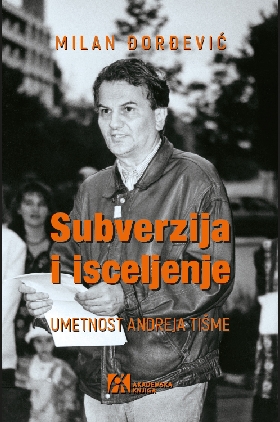
It
is in an ironic, parodying and sarcastic, actually frank, witty and subversive
way that Andrej Tišma utilizes the strategies of the society of spectacle
and the technology of its visual language as a basis of an engaged artistic
production and presentation of an opposing signifying practice of general
symbolic shaping of the society, which communication-wise functions as
a global political actor of the changing perception of reality. Efficient
and empowered by the media, the artistic method of the Debord-type of
guerilla fight for the truth stands for Tišma's sensational approach
to authors' photographic images, and to those found in the virtual space,
also quotations, fragments, symbols, social and cultural references. In
fact, by conceptual molding of the relationships among them, he creates
shocking collage-montages of visual texts, series of digital prints as
provocative political statements of contextually transformed meanings
of image based information. He thus points to the problems of ecology,
bioengineering, genetic engineering, consummerism, cultural uniformity,
imperialistic crimes and the system of colonial exploitation. By subversively
placing the dominant Western visual symbols into different contexts and
new narative entities, Tišma takes a subjective approach in re-interpreting
them and creating new media-constructed meanings of images, in a utopean
endeavor to influence viewers on an international scale, to help them
shed false awareness and to get a different and comprehensive view and
understanding of global events and circumstances. He attempts to create
effects in political and ideological fields through an artistic communicational
diversion against the globally generated neo-liberal identity and meaning
of life of various social subjects, intervening in the culture-coded imaging
order of an estheticized world normality paradigm, which supervises and
controls the public, in a manipulative way psychologically affecting the
perception of reality.
In
a visual reconstruction of the viewer's screen, Tišma mostly uses
a documentary, objective stance towards reality, its contents and facts,
as empirical evidence of dehumanizing negativities. However, paradoxically,
he also makes use of fictional fabrications of reality, photomontage and
computer generated images, as the opponent's weapon in exposing the truth
about the real nature of the world behind his made-by-media false appearance,
optimistically convinced that, in the chaos of information hyperproduction,
his messages will have a significant influence on numerous viewers.
Milan
Djordjevic
(From
the article "Photography In the Art of Andrej Tisma", ASA -
architectyre, science, art, no. 009, Belgrade, October 2021.)
|